
Understanding Your Window of Tolerance and the Impact on Your Health and Nutritional Choices

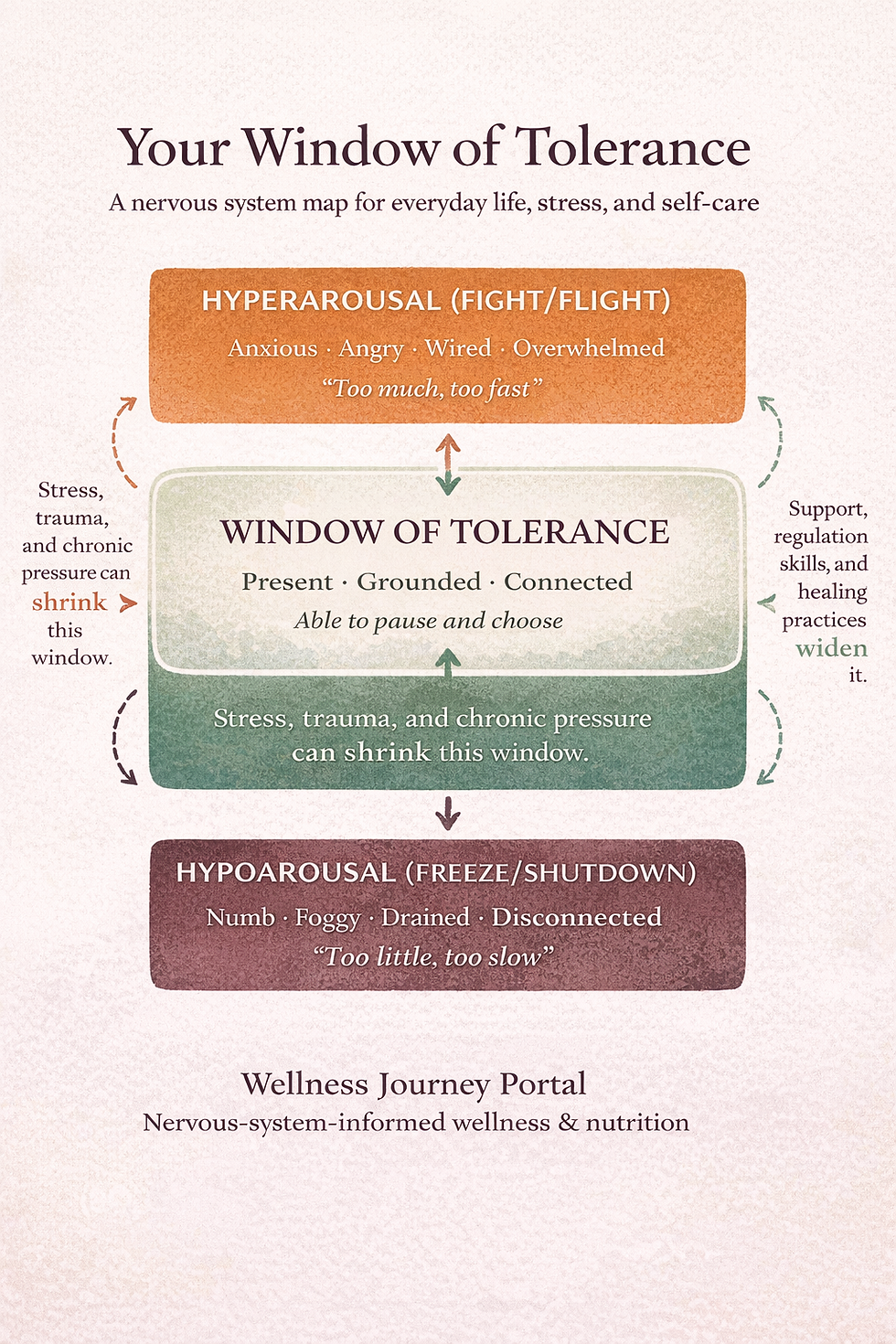
What is the Window of Tolerance?
A nervous system map for everyday life, stress, and self-care
Think of your nervous system like an ecosystem, not a machine.
Your Window of Tolerance is the range where your system feels safe enough to be present, think clearly, and stay connected to yourself and others. The term “Window of Tolerance” was popularized by psychiatrist Dr. Dan Siegel, who helped bring this idea into everyday language. This map builds on decades of earlier work in the trauma and stress fields research on the fight/flight/freeze response and how our nervous systems adapt to overwhelm.
When you’re inside your window, you might still feel stress, but you can:
Notice your emotions without getting swept away
Stay in your body (more or less)
Pause long enough to choose how you want to respond

This is where grounded decisions about food, rest, movement, and boundaries are actually possible.
When you slip outside the window
Life, trauma, oppression, parenting, work, money, health, they all tug on your edges. When there’s too much for too long, your system does what it’s designed to do: protect you. It usually protects you in two directions:
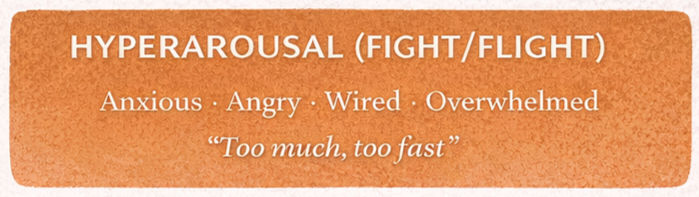
1. HYPERAROUSAL –
“Too much, too fast” (Fight/Flight).
This is the amped-up state. You might notice:
Racing thoughts, worry, or panic
Tight jaw, clenched shoulders, fast heartbeat
Feeling wired, jumpy, irritable, easily triggered
Urges to fix it now, overwork, overdo, overanalyze
Your body is trying to keep you safe by getting you ready to fight or run.

2. HYPOAROUSAL – “I’m done” (Freeze/Shutdown)
This is the numb / shut-down state. You might notice:
Feeling foggy, flat, checked-out, or distant
Moving slowly, thinking “what’s the point?”
Wanting to hide, sleep, scroll, or disappear
Low motivation or zero energy for basic tasks
Here, your body is protecting you by conserving energy and numbing out.
The goal isn’t perfection, it’s return
You’re not meant to stay perfectly in your window all the time. The work of healing is learning to:
Notice where you are (in, above, or below your window)
Offer your body enough safety to come back toward center
Make small, doable choices that match your actual capacity
This is where nervous-system awareness meets wellness, nutrition, and real life.
What shapes your window and how it affects food + wellness
What can shrink or widen your Window of Tolerance?
Your window is alive. It responds to history, context, and support. It can feel narrower when there’s a history of:
Childhood neglect, emotional misattunement, or abuse
Racism, homophobia, transphobia, fatphobia, or other forms of oppression
Chronic stress around money, housing, work, or safety
Long-term illness, pain, or sleep disruption
It can feel wider when you have:
Consistent, emotionally safe relationships
Access to therapy, somatic work, or trauma-informed support
Daily practices that help you regulate (breath, movement, prayer, nature, creativity)
Enough food, rest, and community to feel basically held

Your window is not a character flaw. It’s an adaptation. And it can change.
How leaving your Window can impact food + wellness choices
Once you see your patterns through a nervous-system lens, a lot of your food and wellness choices suddenly make more sense.
In Hyperarousal (amped-up). You might:
Forget to eat, then binge later
Grab quick sugar, caffeine, or ultra-processed foods for a fast “hit”
Eat while rushing, working, scrolling, or caregiving
Use food (or restriction) to try to feel in control
Your body isn’t “misbehaving”, it’s reaching for anything that promises quick energy or soothing.
In Hypoarousal (shut down) You might:
Skip meals because you “don’t feel hungry” or cooking feels impossible
Eat past fullness just to feel something or to self-soothe
Return to familiar comfort foods that signal safety and predictability
Struggle with planning, grocery shopping, or following any routine
Again, this isn’t a lack of willpower. It’s a survival strategy.
Returning to choice, compassion, and care
Try gently asking yourself:
Where am I right now? Inside my window, up above it, or down below it?What would help my body feel just 5% safer?
A few slow exhales - Drinking water
Stepping outside for light and air - Shaking out your hands or shoulders
Reaching out to someone who feels like “home”
From there, you can choose one tiny, nervous-system-friendly action with food or wellness, like:
Eating something nourishing, even if it’s simple
Adding one supportive element (like fiber, protein, or color) to your next meal
Pausing halfway through eating to check in with your body
Over time, these small acts of attunement help expand your Window of Tolerance, so your wellness and nutrition choices are led less by survival and more by self-respect and liberation.
Inside the Wellness Journey Portal, we explore your nervous system, your story, and your plate as one living ecosystem so you can move from survival mode to sustainable, embodied care.